

How Rising Silver Prices Are Impacting Solar Panel Costs
26/01/2026
The global photovoltaic industry is experiencing sustained growth in silver prices — a key raw material used in the production of solar cells. For manufacturers and project developers, this trend is gradually reshaping module cost structures and reinforcing the industry’s focus on high-efficiency technologies.
Swiss Solar continuously monitors raw material markets and evaluates their impact on photovoltaic module manufacturing and technology development.
Silver in Solar Cell Architecture
Silver is used in the form of conductive paste to create front and rear current-collecting fingers and busbars on solar cells. These contacts provide:
- low electrical resistance
- stable current collection
- long-term reliability
Modern high-efficiency technologies such as PERC, TOPCon, TOPCon Advanced and HJT continue to rely on silver metallization because alternative materials do not yet offer the same combination of conductivity and long-term stability.
Current Silver Price Dynamics
Over the past years, silver prices have shown a clear upward trend:
- 2020: approximately 18–20 USD/oz
- 2024: approximately 23–25 USD/oz
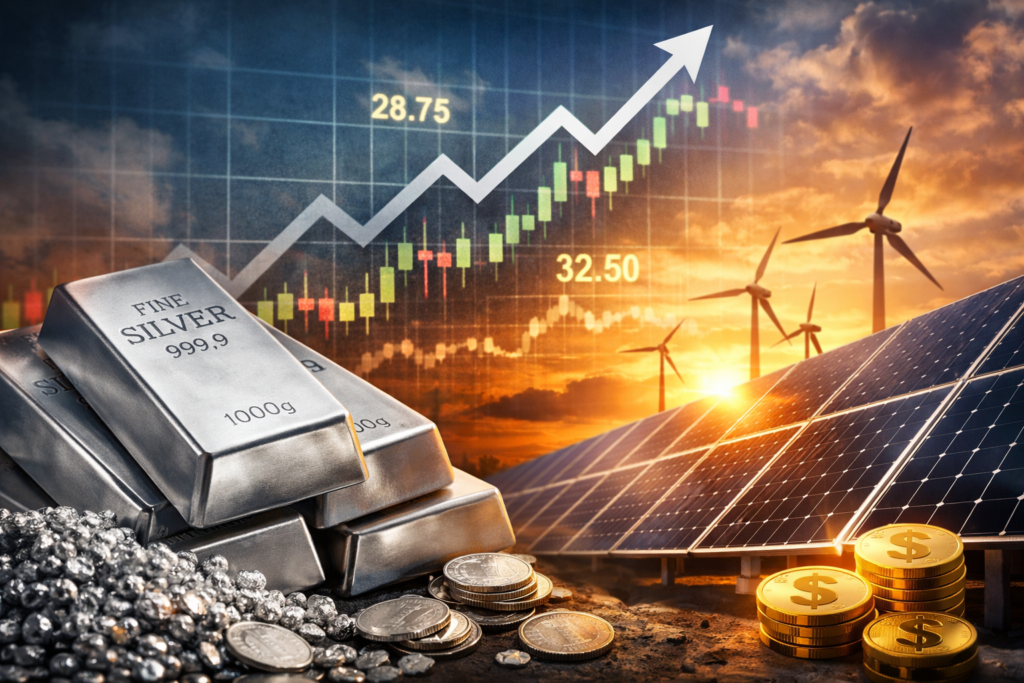
- 2025 – early 2026: 30–32 USD/oz
This represents an overall increase of around 60–70% within five years.
Impact on Cell and Module Cost Structure
Historically, silver accounted for roughly 6–7% of total module manufacturing cost.
Under current market conditions:
- silver paste represents 20–30% of solar cell manufacturing cost
- approximately 10–15% of module manufacturing cost
As a result, silver has become one of the most price-sensitive components in photovoltaic production.
Silver Consumption in Modern Modules
Continuous process optimization has reduced silver usage per cell, yet volumes remain significant:
- 80–120 mg of silver per cell
- 10–14 g of silver per 120-cell module
- 12–17 g of silver per 144-cell module
An increase of 10 USD/oz in silver price translates into an estimated 0.30–0.50 USD increase in module manufacturing cost.
How Rising Silver Prices Affect Module Pricing
Higher silver prices:
- increase manufacturing costs
- put pressure on producer margins
- gradually influence contract pricing
In practice, this can lead to module price increases of approximately 0.5–1.5 US cents/Wp, particularly in the high-efficiency segment.
Industry Technology Responses
To mitigate the impact of rising silver prices, the industry is implementing several strategies:
Silver Thrifting
Optimized metallization patterns and multi-busbar designs have reduced silver consumption per cell by 30–50% over the last five years.
Alternative Pastes and Metallization
Hybrid and copper-based pastes are under development, although large-scale deployment remains limited due to long-term reliability requirements.
Higher Cell Efficiency
Increasing cell efficiency from 21% to 23% can reduce cost per watt by 5–8%, partially offsetting raw material price increases.
Implications for Projects and Investors
For commercial and industrial projects, the impact of higher silver prices typically results in:
- CAPEX increases of approximately 1–3%
- minimal changes to payback periods
Consequently, selecting high-efficiency modules becomes increasingly important to maximize energy yield per gram of silver used.
Swiss Solar Perspective
Swiss Solar views current market conditions as an additional driver for advancing high-efficiency cell technologies, optimizing material usage, and increasing module energy output.
The company remains focused on delivering solutions that combine performance, reliability, and long-term investment value.
Conclusion
Rising silver prices represent a meaningful cost factor for the photovoltaic industry, but they do not alter the fundamental attractiveness of solar energy. Continuous technological innovation and efficiency improvements continue to offset raw material volatility and support the sustainable growth of the global solar market.